
But perhaps it’s this deliberate restriction that lends itself to some interesting interactions between players and novel use of player skills as a means at working better together. While the skill at merely turning a map around to show others sounds ridiculously basic, it’s a clever move in context. A means to build bridges between similarly-plucked team-mates and better incentivises Sea of Thieves’ core, principle lesson in working together. Granted the perk is proven moot when, upon agreeing on a particular voyage, you simply get handed the same maps in your inventory, but the physicality of such interactivity in-game is welcome regardless. When it comes to your ship, though, all hands are most certainly on deck. There are sails to align and angle; potential hazards to flag and shout out to the player steering the ship (whom, if the sails are set at full length can’t see where they’re steering, again a nice nudging toward better relationships)…and if worse comes to worse, leaks to repair should you collide. Or even worse, cries of “FRAME-RATE!” — as I had to do when a teammate is barking compass directions but I have no means to control the stuttering performance — when the game (on PC) decides to nose-dive from relatively stable 60FPS to, at its worst, the high-teens — the most notable drops occurring mostly at sea, relatively afar from shore.
Some prospective Sea of Thieves players may question the decision to include microtransactions, but Neate has an explanation for the business model. “Ultimately I have to look at the reality of running a game-as-service as a business,” says the executive producer, adding that “My goal and everyone else’s goal here is to have as many people as possible working on this, and just keep giving people reasons to return, reasons to have fun. We have to run that like a business, you need revenue coming
According to Rare, the studio wants to offer a balanced experience that’s equal in almost every facet. In practice, that means a game with full feature parity, but more than that it means an equal playing field from day one. So Rare also says they’re planning on launching Sea of Thieves online guide|https://seaofthievesfans.com/ of Thieves day and date on both console and PC, with launch still on track for early 2
Then there’s the workings and actual programming side of the ocean itself, particularly the many ways in which the waves crash and tumble against your ship. The textures and dynamics, the way they sway to and fro, sending a once calm voyage into potentially risky affairs; I’ve plenty to say on this feature alone, so I’ll leave it at that for the time being. In terms of gameplay, wherein (least in the beta build) you can decide to go it alone, team up with another or join a party of four, Sea of Thieves is a hands-on, labor-focused experience, stripping away all hereditary comforts with the interface such as a mini-map or objective indicators alike in favor of more communicative and team-based, working together.
Tomas: Fortunately I stopped and Azario was able to get back on the ship after about a minute of swimming, and we continued our voyage to the island. It was smooth sailing (pun intended) from there. Once we reached the island, I had someone shoot me out of a cannon onto the isl
I’m not suggesting there be some kind of grind or loot-based collectathon (Rare certainly know how to do collectathons, but perhaps they best steer away from that concept for the time being) that hooks players into getting better/faster/stronger/more resilient, but more importantly, coming back for more. Whether it’s the bare simplicity of island design, the lack of any real management structure aboard your ship or just the general transparency of its world’s engagement, Sea of Thieves feels just like one of those temporary respites prior to some grander investment in another game. Something you muck about with for an hour and nothing more. And for something as crucial as it’s been for someone like myself who seldom indulges in online multiplayer, while Sea of Thieves gets the teamwork principle down…then what?
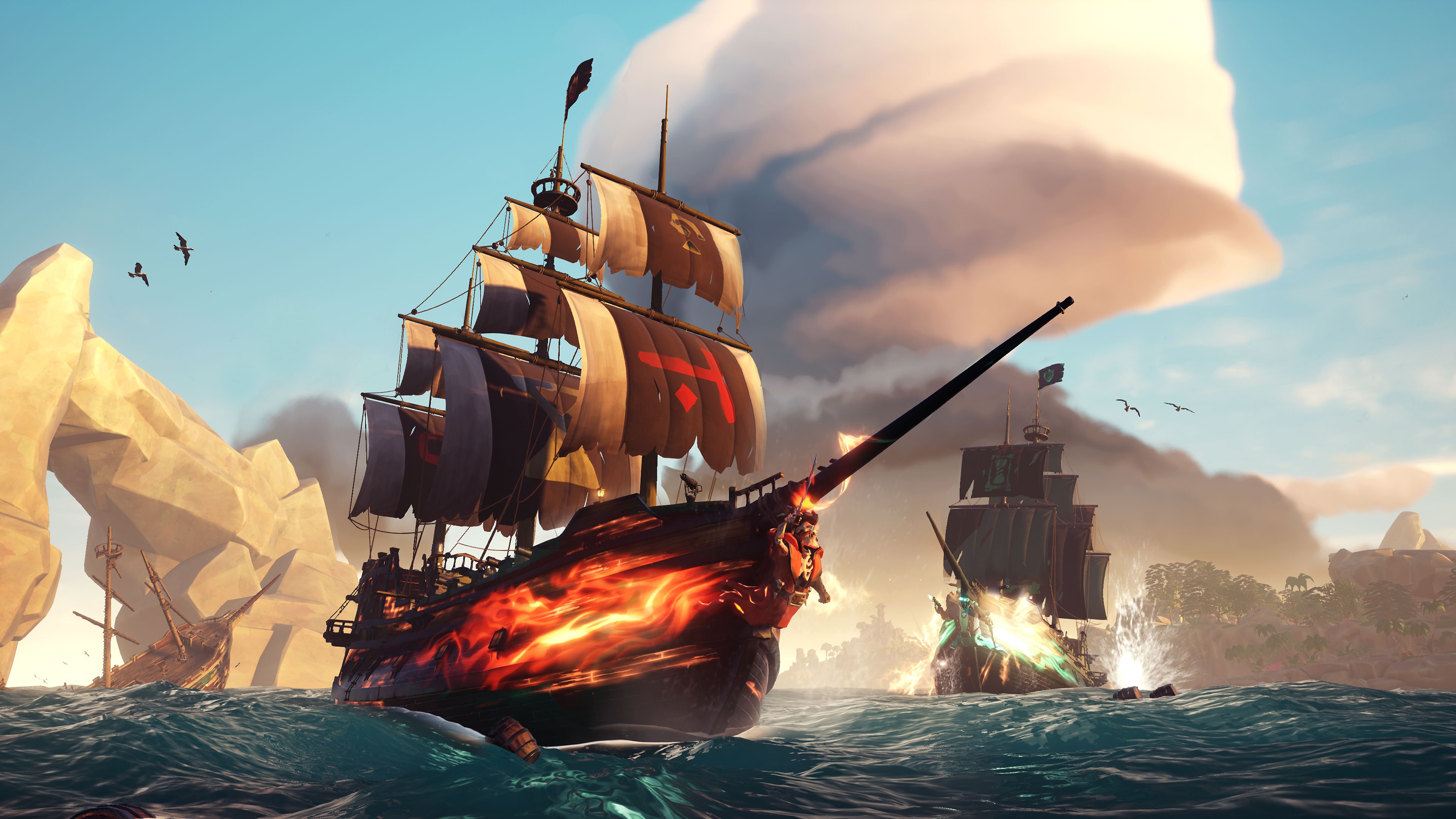 Tomas: I was surprised by how involved and dynamic it all was. I took the role of captain, so I had to steer the ship towards our destination. My vision was impaired by the sails, but I knew the island we were heading to was Northwest, so I had to use the compass to aim the ship in direction. It’s a level of involvement you don’t often see in games, but it felt quite fitting for one with pira
Is this a game of substance or a game of potential — clambering to the hope that players will “just make their own fun?” Yes, there’s a little silliness and due reactionary disbelief as you watch your ship sink beneath the ocean as a swell of string arrangement signal open water once more being the most terrifying concept in existence (especially at night), but these are unintended accidents outside the supposed “bulk” of the game’s content. When you seemingly have more engagement in the surprisingly-detailed ocean physics — rather than the focal content on show — well then that’s a problem. And in Microsoft’s/Xbox’s case, a big problem.